Date: 2026.08.15 Click: 7
You cannot pick one air-boosting system as the best choice for every car. A turbocharger gives you the best gas mileage and strong high-speed power. On the other hand, a supercharger provides smooth power and quick gas-pedal response without any delay. Both performance-boosting tools greatly increase engine power, but you must accept major downsides with each choice.
This turbocharger vs supercharger comparison checks both air-boosting systems head-to-head across important vehicle measurements. You will look at key testing factors including how they work, gas mileage effects, setup difficulty, heat control, and daily driving use. Looking closely at these performance details helps you pick the ideal setup for your driving habits.
Key TakeawaysTurbochargers reuse hot waste gas to boost engine power and improve gas mileage by up to 25 percent.
Superchargers use power from the engine belt to give drivers fast speed without any waiting delay.
Superchargers attach directly to engines quite easily, but turbochargers need pricey custom pipes and complicated adjustments.
Superchargers need easy long-term care, but turbochargers require regular oil changes to stop heat damage.
You can easily see how turbochargers and superchargers differ by looking at how they are powered. Both of these systems boost power by forcing extra compressed air right into your engine cylinders. A standard supercharger sits on top of your engine. It connects directly to the crankshaft with a rubber belt. As the crankshaft turns, it spins the supercharger rotors right away.
This setup gives you instant power the moment you press the gas pedal. The turning rotors push thick air into your engine even at low speeds. However, this belt connection creates a drawback called parasitic load. The supercharger must use some engine power just to spin its own heavy parts. Your car loses a bit of energy to run the system, which lowers your overall efficiency.
A turbocharger works in a totally different way by using leftover exhaust gas for power. Instead of using a belt, it attaches to the engine exhaust manifold. Hot exhaust gases rush out of the cylinders and flow into a turbine housing. These gases spin turbine blades and a tiny shaft at super high speeds. This spinning shaft turns a compressor wheel that pulls in fresh air and squeezes it tight.
This smart design lets you catch energy that usually gets wasted out of the tailpipe as heat. The compressor pumps extra air into the engine without pulling power from the crankshaft. By reusing this lost energy, your engine makes much more power while staying efficient. You get a big speed boost without adding extra drag to the engine.
Turbocharger Benefits and Tradeoffs
An exhaust-driven turbocharger improves gas mileage by 20% to 25% over a supercharger setup. It traps wasted heat straight from outgoing exhaust gases. This process changes lost energy into extra engine power. You gain top performance without creating extra drag on your motor. Auto companies use this method to build smaller engines that still produce high horsepower.
A turbocharged engine creates huge power from a tiny footprint. You can swap out large engines for smaller, high-efficiency choices. The table below compares different engine sizes that produce equal power outputs:
|
Turbocharged modern engine |
Traditional naturally aspirated engine |
Displacement reduction |
|---|---|---|
|
2.0 L four-cylinder |
3.5 L V6 |
1.5 L (~43% smaller) |
|
2.0 L at 1.5 bar boost |
3.0 L |
1.0 L (~33% smaller) |
This lighter build lowers total vehicle weight. Your car consumes less fuel during normal highway driving. You still get great horsepower output whenever you push the gas pedal down.
Boost lag stands out as the main downside to using this system. Boost lag means the brief pause before exhaust gas pressure builds inside the housing. When you hit the gas pedal, the car pauses for a brief moment. The turbine wheel requires time to speed up and squeeze incoming air. Newer turbocharger setups help cut down this pause quite a bit.
High heat creates another large mechanical problem for your turbocharger parts. Hot exhaust flows warm up the whole system fast during hard acceleration. You must manage this heat carefully so components survive tough driving setups:
Turbine inlet exhaust gas can top 1875°F (1025°C) and cause severe rust damage.
Most factory turbines handle steady heat limits up to 1750°F (950°C).
Heat strain reaches up to 140 MPa around the wastegate seat area.
Modern liquid-cooled turbine housings keep inner temperatures below 662°F and outer parts below 248°F.
You need to manage these high heat levels using good oil lines and engine coolants. Careful care keeps your turbocharger working well over time. These smart cooling systems save inner bearings from wearing out on long drives.
Supercharger Advantages and DisadvantagesStep on the gas in a supercharged car, and you feel quick speed right away. A sturdy drive belt links the blower right to the main engine pulley. The inner rotors start turning the exact second you touch the gas pedal. You never experience lag because the air supply grows alongside your engine speed. Thanks to this direct setup, extra air enters your engine without any delay.
This fast power helps your car launch with great strength from a full stop. A supercharged engine provides smooth, steady energy through every gear. You never need to wait for hot exhaust gas to build up pressure. You can easily control your speed on steep road ramps, quick passing lanes, or sharp racetrack turns.
All superchargers pull extra power right from the engine to squeeze incoming air. This strong physical link creates energy drag on your motor. The engine actually wastes its own horsepower just to turn those heavy inner rotors. The chart shows how much power a 5.0L V8 loses at 6,000 RPM using three common builds:
|
Supercharger Type on 5.0L V8 |
Horsepower Consumption at 6,000 RPM |
|---|---|
|
Roots supercharger |
22–28 hp |
|
Twin-screw supercharger |
15–20 hp |
|
Centrifugal supercharger |
12–18 hp |
When driving fast near 6,000 RPM, a regular supercharger uses 15–30 hp just to spin. You trade away some gas mileage to get that quick low-speed power. Also, a supercharger creates warmer intake air than a turbocharger setup does. Squeezing air so fast makes high heat inside the engine manifold. You need a good intercooler to chill this air and shield your engine parts from heat damage.
Turbocharger vs Supercharger Direct ComparisonComparing a turbocharger vs supercharger setup requires you to look beyond simple top-speed horsepower numbers. You must evaluate real-world installation work, hardware prices, maintenance needs, and mechanical energy delivery. Both forced induction setups transform your vehicle into a high-performance machine. However, each system forces you to manage distinct mechanical layout challenges, tuning expenses, and dynamic vehicle driving behaviors.
You will find that physical engine setup procedures differ greatly between these two forced induction designs. Installing a supercharger onto your motor remains a clean, straightforward task for most mechanics. The unit bolt-mounts directly onto the upper intake manifold of your engine. A dedicated drive belt hooks right into the existing pulley system. This compact placement eliminates the need for massive under-hood alterations or custom pipe routing.
Conversely, fitting a turbocharger into your car requires far more labor hours, custom fabrications, and specialized hardware parts. You must completely reroute your exhaust gas pathways through dedicated custom headers to feed the turbine housing. You also need to run high-pressure oil feed lines and cooling lines to safeguard the central spinning shaft during operation.
According to automotive build standards, a turbocharger installation increases overall project costs over a simpler supercharger setup because it requires:
Exhaust system modifications
Engine management modifications
Additional parts such as intercoolers and piping
Precise tuning
These extra components add substantial mechanical expense to your build project. You must pay for expensive custom exhaust work to fit the turbine housing properly. You also need to purchase high-flow intercooler pipes and cooling radiators to chill hot compressed air. Finally, your professional mechanic must spend extra shop hours running custom engine computer software tunes. Without precise fuel control and ignition timing adjustments, your upgraded motor risks severe heat damage during hard acceleration.
You will notice massive operational differences in power delivery as you press down on the gas pedal. A supercharger creates a very smooth, linear boost response across your entire RPM range. The mechanical belt connection spins the inner blower rotors in direct harmony with your main crankshaft speeds. Low-speed throttle movements yield immediate acceleration. You receive instant pull right off the starting line without waiting for internal system pressure to build.
In contrast, a turbocharger generates an exponential, high-end power surge. The whole system relies entirely on rising waste exhaust volume to turn the inner turbine wheel. Low RPM driving offers standard engine performance while exhaust gas pressures remain minimal. Once your engine hits medium RPM levels, exhaust flow spins the turbine rapidly. This mechanical action creates a sudden burst of boost energy that pushes your car forward with extreme force.
This rapid power surge makes highway passing lanes and track racing feel incredibly thrilling. You get massive energy gains at high vehicle speeds without placing heavy parasitic engine drag on your main crankshaft. However, managing this sudden thrust demands careful driver steering inputs. You must adjust your daily driving style to handle the dynamic shift between quiet idle cruising and sudden peak vehicle acceleration.
Which Forced Induction System Is Better?Picking the right power boost depends on what you want from your car. Think about your daily drive habits and how much upkeep work you want to handle.
Your final pick will change how you take care of your car. A supercharger works with low overall care needs across its entire life.
|
Component / Action |
Supercharger recommended interval |
|---|---|
|
Supercharger oil |
No routine oil change; sealed synthetic oil can last very long (often 400,000+ miles) |
|
Drive belt |
Inspect periodically at oil changes; replace if worn (typically 50,000+ miles) |
|
Air intake filter |
Clean/replace every 10,000–15,000 miles if oiled gauze filter |
|
Intercooler coolant |
Check level occasionally; closed loop with long flush intervals |
|
Daily-driving care |
Low-maintenance; normal engine oil changes and premium fuel still apply |
You spend less time fixing things when running a simple blower. Thick synthetic fluid lasts over 400,000 miles without any help. You only replace the main belt past 50,000 miles. But a turbocharger needs more regular work to shield key inner parts.
|
Component / Action |
Turbocharger recommended interval |
|---|---|
|
Engine oil change |
Every 5,000 miles or 3 months |
|
Turbocharger inspection/service |
Every 30,000–60,000 miles |
|
Oil level check |
At least monthly |
|
Daily-driving care |
Warm up before driving, avoid lugging, and cool down before shutdown after hard driving |
You must refresh engine oil every 5,000 miles or three months for turbos. Check fluid lines every single month. High heat means you must warm up the engine first. Let parts cool before turning off the car after fast drives.
Pulling heavy trailers takes steady power under load. Distinct setup designs show huge differences in work strength across similar truck frames.
|
Engine |
Towing Capacity (lbs) |
Difference vs. Supercharged V8 (lbs) |
|---|---|---|
|
5.2L Supercharged V8 |
8,700 |
Reference |
|
2.7L EcoBoost Turbo V6 |
8,400 |
+300 for Supercharged V8 |
|
3.5L EcoBoost Turbo V6 |
13,500 |
+4,800 for Turbo V6 |
|
High Output 3.5L EcoBoost Turbo V6 |
8,200 |
+500 for Supercharged V8 |
Official tow ratings for new Ford F-150 trucks prove these key limits.
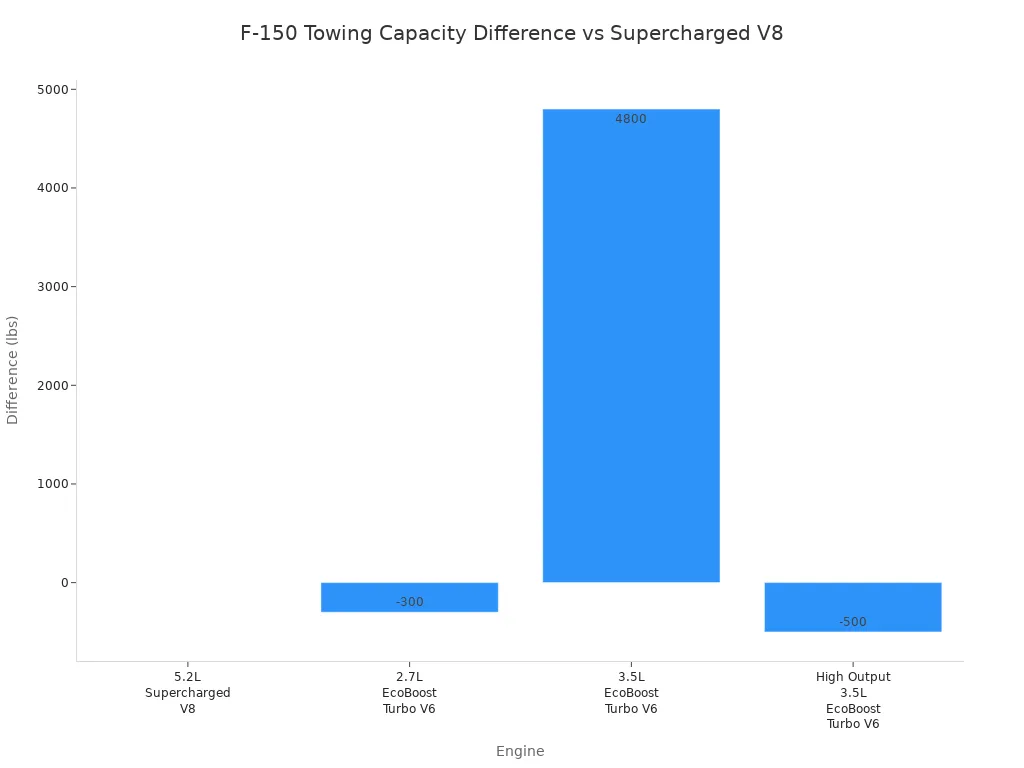
A 5.2L Supercharged V8 carries up to 8,700 pounds. The 3.5L EcoBoost Turbo V6 pulls 13,500 pounds. That gives the twin-turbo setup a big 4,800-pound win. Yet the High Output 3.5L EcoBoost Turbo V6 pulls 8,200 pounds. That gives the Supercharged V8 a 500-pound lead over that build.
On twisty tracks, quick gas response shoots you out of tight turns fast. Drag racers like instant force right off the start line. Highway drivers want top-end speed gains instead. Match your car setup to where you drive most.
Choosing between a turbocharger vs supercharger comes down to your personal performance goals. A turbocharger optimizes engine energy efficiency by using leftover waste exhaust gas, and it delivers impressive top-end power. Conversely, a supercharger provides instant off-the-line throttle response and zero boost lag, though parasitic drag lowers overall fuel efficiency.
You should pick a supercharger for heavy towing tasks, classic muscle cars, or immediate low-speed power delivery. You should select a turbocharger for modern daily driving, small engine tuning, and maximum fuel economy optimization. Always evaluate your under-hood engine space constraints, project budget, and personal driving habits before buying any forced induction kit.
FAQTurbochargers provide much better gas mileage when you drive every day. They run on hot exhaust gases instead of pulling extra power directly from your engine crankshaft. Reusing this wasted energy improves your total fuel economy by 20% to 25% over a supercharger design.
No, a supercharger operates with zero boost lag at any speed. A tough drive belt links the blower directly to your main engine pulley system. These internal parts spin immediately the moment you push down on your gas pedal. This setup provides fast air pressure and steady power output right away from low speeds.
A supercharger normally costs less money to install on your car. A mechanic simply bolts the whole unit straight onto your main air intake manifold. Installing a turbocharger requires much more labor because your shop must custom-route exhaust pipes, fit oil feed lines, and reprogram your engine computer.
You need to swap your engine oil every 5,000 miles or three months inside a turbocharged vehicle. Intense exhaust heat built up inside this system spoils your clean oil very fast. Frequent oil changes safeguard the fast-spinning shaft and keep internal bearings working safely over time.
Please leave your requirements and contact information, and we will send you the quotation information as soon as possible.